

Excel Pumping, Piping, and Fluid Mechanics Systems: This page contains Excel files (mix of “flat” xlsx and “macro-enabled” xlsm). Each file represents a worked-out application for an engineering problem assocated with fluid pumping or piping systems. Use these example problems to refresh your memory on the fundamentals you covered in fluid mechanics class.
Friction Factor, f, Automated Moody Diagram Tool — Download this file to learn how to determine the friction factor, f, analytically when you know the Reynolds Number and the relative roughness in pipe flow. This simple file helps you to save time over visually determining f from the graphical Moody Diagram.

Pipe Size Table — Simple table of NPS (nominal pipe size) diameters based on nominal size and schedule (pipe thickness for various pressure levels).

Pipe Flow Analysis Tool — powerful tool for pipe flow calculations.
Pipe and Pump Operating Point — example problem illustrating how to dermine where a pump curve (H vs Q) intersects from the piping system load curve (H vs Q), indicating the system operating point.
Analytical Pump Curve Characterization — illustrates how to analytically characterize the head vs flow (H vs Q) relationship for a pump with multiple candidate impeller diameters with a family of third-order polynomials. Same approach for characterizing pump efficiency and pump power required.
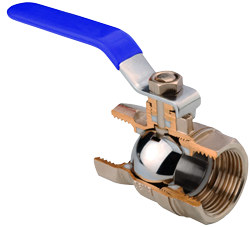
Characterize Control Valves: One-stop-shop for characterizing the head vs flow behavior of most all types and sizes of flow control valves: globe, butterfly, ball, v-port ball. Two coefficients are used: the valve-wide-open Cv and the PercentWideOpen Cv coefficients. A derivation is shown to transform the valve flow coefficient into an equivalent resistance coefficient, K, where K = fL/d for a pipe model.
Horizontal Rectangular Jet Flow: A horizontal rectangular jet is a method for modeling the supply of a dilute mixture from the headbox of a paper machine onto the forming section. This geometry is applied in other industrial applications as well. This Excel file provides the computational approach, and source documentation for determining the exit angle and contraction coefficient of the incompressible fluid jet.